

Specific Heat Of Sodium Hydroxide
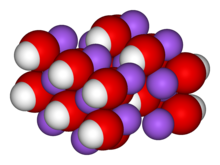 | |
 | |
| Names | |
|---|---|
| IUPAC proper noun Sodium hydroxide[3] | |
Other names
| |
| Identifiers | |
| CAS Number |
|
| 3D model (JSmol) |
|
| ChEBI |
|
| ChemSpider |
|
| ECHA InfoCard | 100.013.805 |
| EC Number |
|
| E number | E524 (acidity regulators, ...) |
| Gmelin Reference | 68430 |
| KEGG |
|
| MeSH | Sodium+Hydroxide |
| PubChem CID |
|
| RTECS number |
|
| UNII |
|
| UN number | 1824, 1823 |
| CompTox Dashboard (EPA) |
|
| InChI
| |
| SMILES
| |
| Properties | |
| Chemical formula | NaOH |
| Molar mass | 39.9971 m/mol |
| Appearance | White, hard (when pure), opaque crystals |
| Smell | odorless |
| Density | two.13 g/cmiii [4] |
| Melting signal | 323 °C (613 °F; 596 Chiliad)[4] |
| Boiling signal | 1,388 °C (2,530 °F; 1,661 K)[iv] |
| Solubility in water | 418 g/Fifty (0 °C) 1000 thou/L (25 °C)[4] 3370 thou/L (100 °C) |
| Solubility | soluble in glycerol, negligible in ammonia, insoluble in ether, slowly soluble in propylene glycol |
| Solubility in methanol | 238 g/L |
| Solubility in ethanol | <<139 thousand/L |
| Vapor pressure | <2.4 kPa (at 20 °C) |
| Acidity (pThousand a) | 15.7 |
| Magnetic susceptibility (χ) | −xv.viii·x−6 cm3/mol (aq.)[5] |
| Refractive alphabetize (n D) | ane.3576 |
| Structure[6] | |
| Crystal structure | Orthorhombic, oS8 |
| Infinite group | Cmcm, No. 63 |
| Lattice constant | a = 0.34013 nm, b = one.1378 nm, c = 0.33984 nm |
| Formula units (Z) | four |
| Thermochemistry[vii] | |
| Heat capacity (C) | 59.v J/(mol·Grand) |
| Std tooth | 64.4 J/(mol·K) |
| Std enthalpy of | −425.8 kJ/mol |
| Gibbs gratis energy (Δf Grand ⦵) | -379.7 kJ/mol |
| Hazards | |
| GHS labelling: | |
| Pictograms |  |
| Bespeak word | Danger |
| Hazard statements | H290, H314 |
| Precautionary statements | P280, P305+P351+P338, P310 |
| NFPA 704 (fire diamond) | three 0 i ALK |
| Lethal dose or concentration (LD, LC): | |
| LD50 (median dose) | 40 mg/kg (mouse, intraperitoneal)[9] |
| LDLo (everyman published) | 500 mg/kg (rabbit, oral)[10] |
| NIOSH (US health exposure limits): | |
| PEL (Permissible) | TWA two mg/mthree [eight] |
| REL (Recommended) | C 2 mg/k3 [8] |
| IDLH (Firsthand danger) | 10 mg/m3 [8] |
| Safety data sheet (SDS) | External SDS |
| Related compounds | |
| Other anions |
|
| Other cations | {{ublLithium hydroxide|Potassium hydroxide|Rubidium hydroxide|Caesium hydroxide|Francium hydroxide}} |
| Related compounds | Sodium deuteroxide |
| Except where otherwise noted, data are given for materials in their standard state (at 25 °C [77 °F], 100 kPa). Infobox references | |


Sodium hydroxide, as well known as lye and caustic soda,[1] [ii] is an inorganic compound with the formula NaOH. Information technology is a white solid ionic compound consisting of sodium cations Na+ and hydroxide anions OH− .
Sodium hydroxide is a highly caustic base of operations and alkali that decomposes proteins at ordinary ambience temperatures and may cause severe chemical burns. It is highly soluble in water, and readily absorbs moisture and carbon dioxide from the air. It forms a series of hydrates NaOH·northHtwoO.[11] The monohydrate NaOH·H2O crystallizes from water solutions between 12.iii and 61.eight °C. The commercially available "sodium hydroxide" is oft this monohydrate, and published data may refer to information technology instead of the anhydrous compound.
As one of the simplest hydroxides, sodium hydroxide is ofttimes used alongside neutral water and acidic hydrochloric acrid to demonstrate the pH scale to chemistry students.[12]
Sodium hydroxide is used in many industries: in the industry of pulp and paper, textiles, drinking water, soaps and detergents, and equally a drain cleaner. Worldwide production in 2004 was approximately 60 million tons, while demand was 51 million tons.[13]
Properties [edit]
Physical properties [edit]
Pure sodium hydroxide is a colorless crystalline solid that melts at 318 °C (604 °F) without decomposition, and with a boiling betoken of 1,388 °C (2,530 °F). It is highly soluble in water, with a lower solubility in polar solvents such every bit ethanol and methanol.[fourteen] NaOH is insoluble in ether and other non-polar solvents.
Similar to the hydration of sulfuric acrid, dissolution of solid sodium hydroxide in water is a highly exothermic reaction[15] where a big amount of heat is liberated, posing a threat to safety through the possibility of splashing. The resulting solution is usually colorless and odorless. As with other alkaline solutions, it feels glace with peel contact due to the process of saponification that occurs between NaOH and natural peel oils.
Viscosity [edit]
Full-bodied (50%) aqueous solutions of sodium hydroxide accept a feature viscosity, 78 mPa·s, that is much greater than that of h2o (i.0 mPa·s) and near that of olive oil (85 mPa·s) at room temperature. The viscosity of aqueous NaOH, as with whatsoever liquid chemic, is inversely related to its service temperature, i.east., its viscosity decreases as temperature increases, and vice versa. The viscosity of sodium hydroxide solutions plays a straight role in its awarding as well as its storage.[14]
Hydrates [edit]
Sodium hydroxide can class several hydrates NaOH·nH2O, which consequence in a circuitous solubility diagram that was described in detail past South. U. Pickering in 1893.[16] The known hydrates and the judge ranges of temperature and concentration (mass percent of NaOH) of their saturated water solutions are:[11]
- Heptahydrate, NaOH·7H2O: from −28 °C (18.8%) to −24 °C (22.2%).[16]
- Pentahydrate, NaOH·5HtwoO: from −24 °C (22.2%) to −17.7 (24.eight%).[16]
- Tetrahydrate, NaOH·4H2O, α class: from −17.vii (24.8%) to +five.4 °C (32.5%).[16] [17]
- Tetrahydrate, NaOH·4HiiO, β form: metastable.[16] [17]
- Trihemihydrate, NaOH·3.5HiiO: from +5.4 °C (32.5%) to +15.38 °C (38.viii%) and then to +v.0 °C (45.seven%).[16] [11]
- Trihydrate, NaOH·3H2O: metastable.[16]
- Dihydrate, NaOH·2H2O: from +five.0 °C (45.7%) to +12.three °C (51%).[16] [eleven]
- Monohydrate, NaOH·H2O: from +12.3 °C (51%) to 65.10 °C (69%) then to 62.63 °C (73.1%).[16] [eighteen]
Early reports refer to hydrates with north = 0.v or n = ii/3, just after careful investigations failed to ostend their existence.[18]
The only hydrates with stable melting points are NaOH·H2O (65.10 °C) and NaOH·three.5H2O (15.38 °C). The other hydrates, except the metastable ones NaOH·3H2O and NaOH·4H2O (β) can be crystallized from solutions of the proper composition, equally listed above. All the same, solutions of NaOH tin be easily supercooled by many degrees, which allows the formation of hydrates (including the metastable ones) from solutions with different concentrations.[11] [18]
For example, when a solution of NaOH and h2o with 1:2 mole ratio (52.6% NaOH by mass) is cooled, the monohydrate normally starts to crystallize (at virtually 22 °C) earlier the dihydrate. Yet, the solution tin hands be supercooled down to −xv °C, at which point it may quickly crystallize every bit the dihydrate. When heated, the solid dihydrate might melt directly into a solution at 13.35 °C; yet, in one case the temperature exceeds 12.58 °C. it often decomposes into solid monohydrate and a liquid solution. Fifty-fifty the n = 3.five hydrate is difficult to crystallize, because the solution supercools so much that other hydrates become more stable.[11]
A hot water solution containing 73.1% (mass) of NaOH is a eutectic that solidifies at about 62.63 °C as an intimate mix of anhydrous and monohydrate crystals.[19] [18]
A second stable eutectic composition is 45.4% (mass) of NaOH, that solidifies at about 4.9 °C into a mixture of crystals of the dihydrate and of the iii.v-hydrate.[11]
The third stable eutectic has 18.4% (mass) of NaOH. Information technology solidifies at about −28.seven °C as a mixture of water water ice and the heptahydrate NaOH·7HiiO.[sixteen] [xx]
When solutions with less than 18.4% NaOH are cooled, water ice crystallizes offset, leaving the NaOH in solution.[16]
The α class of the tetrahydrate has density 1.33 1000/cm3. It melts congruously at vii.55 °C into a liquid with 35.7% NaOH and density 1.392 grand/cmiii, and therefore floats on it like ice on water. Withal, at near four.9 °C information technology may instead melt incongruously into a mixture of solid NaOH·3.5HtwoO and a liquid solution.[17]
The β form of the tetrahydrate is metastable, and often transforms spontaneously to the α form when cooled below −20 °C.[17] One time initiated, the exothermic transformation is complete in a few minutes, with a six.v% increase in volume of the solid. The β course can exist crystallized from supercooled solutions at −26 °C, and melts partially at −1.83 °C.[17]
The "sodium hydroxide" of commerce is oft the monohydrate (density 1.829 grand/cm3). Concrete information in technical literature may refer to this form, rather than the anhydrous compound.
Crystal construction [edit]
NaOH and its monohydrate form orthorhombic crystals with the space groups Cmcm (oS8) and Pbca (oP24), respectively. The monohydrate cell dimensions are a = 1.1825, b = 0.6213, c = 0.6069 nm. The atoms are bundled in a hydrargillite-like layer structure, with each sodium atom surrounded by half-dozen oxygen atoms, three each from hydroxide ions and three from h2o molecules. The hydrogen atoms of the hydroxyls grade strong bonds with oxygen atoms within each O layer. Adjacent O layers are held together by hydrogen bonds between water molecules.[21]
Chemical properties [edit]
Reaction with acids [edit]
Sodium hydroxide reacts with protic acids to produce h2o and the corresponding salts. For example, when sodium hydroxide reacts with hydrochloric acid, sodium chloride is formed:
- NaOH(aq) + HCl(aq) → NaCl(aq) + H2O(l)
In general, such neutralization reactions are represented by 1 unproblematic cyberspace ionic equation:
- OH−(aq) + H+(aq) → HtwoO(fifty)
This type of reaction with a potent acid releases oestrus, and hence is exothermic. Such acrid–base reactions can also be used for titrations. However, sodium hydroxide is not used as a primary standard considering it is hygroscopic and absorbs carbon dioxide from air.
Reaction with acidic oxides [edit]
Sodium hydroxide also reacts with acidic oxides, such as sulfur dioxide. Such reactions are oftentimes used to "scrub" harmful acidic gases (similar And sotwo and HiiS) produced in the burning of coal and thus prevent their release into the atmosphere. For example,
- 2 NaOH + And soii → NaiiAnd thenthree + H2O
Reaction with metals and oxides [edit]
Glass reacts slowly with aqueous sodium hydroxide solutions at ambient temperatures to grade soluble silicates. Because of this, glass joints and stopcocks exposed to sodium hydroxide take a trend to "freeze". Flasks and drinking glass-lined chemical reactors are damaged by long exposure to hot sodium hydroxide, which also frosts the drinking glass. Sodium hydroxide does not set on iron at room temperatures, since iron does non take amphoteric backdrop (i.e., it but dissolves in acid, non base). Withal, at loftier temperatures (e.g. above 500 °C), fe can react endothermically with sodium hydroxide to course iron(III) oxide, sodium metal, and hydrogen gas.[22] This is due to the lower enthalpy of germination of atomic number 26(III) oxide (−824.ii kJ/mol) compared to sodium hydroxide (-500 kJ/mol) and positive entropy change of reaction, which imply spontaneity at loftier temperatures (ΔST > ΔH, ΔG < 0) and not-spontaneity at low temperatures (ΔST < ΔH, ΔG > 0). Consider the following reaction betwixt molten sodium hydroxide and finely divided fe filings:
- 4 Atomic number 26 + 6 NaOH → 2 FetwoO3 + six Na + 3 Hii
A few transition metals, all the same, may react vigorously with sodium hydroxide under milder conditions.
In 1986, an aluminium route tanker in the Great britain was mistakenly used to ship 25% sodium hydroxide solution,[23] causing pressurization of the contents and damage to the tanker. The pressurization was due to the hydrogen gas which is produced in the reaction between sodium hydroxide and aluminium:
- two Al + ii NaOH + 6 H2O → two Na[Al(OH)iv] + iii Hii
Precipitant [edit]
Unlike sodium hydroxide, which is soluble, the hydroxides of nigh transition metals are insoluble, and therefore sodium hydroxide tin be used to precipitate transition metallic hydroxides. The following colours are observed:
- Copper - bluish
- Iron(II) - green
- Atomic number 26(3) - xanthous / brown
Zinc and lead salts dissolve in excess sodium hydroxide to give a articulate solution of Na2ZnO2 or Na2PbO2 .
Aluminium hydroxide is used as a gelled flocculant to filter out particulate matter in water treatment. Aluminium hydroxide is prepared at the handling constitute from aluminium sulfate past reacting it with sodium hydroxide or bicarbonate.
- Al2(Thenfour)3 + 6 NaOH → 2 Al(OH)3 + iii Na2SO4
- Al2(And so4)3 + 6 NaHCOthree → two Al(OH)three + 3 NatwoSo4 + vi COtwo
Saponification [edit]
Sodium hydroxide can be used for the base of operations-driven hydrolysis of esters (every bit in saponification), amides and alkyl halides.[fourteen] However, the express solubility of sodium hydroxide in organic solvents means that the more soluble potassium hydroxide (KOH) is often preferred. Touching a sodium hydroxide solution with bare hands, while not recommended, produces a slippery feeling. This happens because oils on the skin such as sebum are converted to lather. Despite solubility in propylene glycol it is unlikely to replace h2o in saponification due to propylene glycol's primary reaction with fat before reaction between sodium hydroxide and fat.
| Mass fraction of NaOH (wt%) | 4 | 10 | 20 | 30 | 40 | 50 |
|---|---|---|---|---|---|---|
| Molar concentration of NaOH (M) | ane.04 | 2.77 | 6.09 | 9.95 | 14.30 | 19.05 |
| Mass concentration of NaOH (g/L) | 41.seven | 110.9 | 243.8 | 398.three | 572.0 | 762.2 |
| Density of solution (1000/mL) | 1.043 | i.109 | 1.219 | 1.328 | 1.430 | i.524 |
Production [edit]
Sodium hydroxide is industrially produced as a 50% solution by variations of the electrolytic chloralkali procedure.[24] Chlorine gas is also produced in this procedure.[24] Solid sodium hydroxide is obtained from this solution by the evaporation of water. Solid sodium hydroxide is almost commonly sold as flakes, prills, and cast blocks.[13]
In 2004, world product was estimated at 60 million dry tonnes of sodium hydroxide, and demand was estimated at 51 million tonnes.[thirteen] In 1998, full globe production was around 45 million tonnes. North America and Asia each contributed around 14 million tonnes, while Europe produced around ten million tonnes. In the United States, the major producer of sodium hydroxide is Olin, which has annual production around v.7 million tonnes from sites at Freeport, Texas, and Plaquemine, Louisiana, St Gabriel, Louisiana, McIntosh, Alabama, Charleston, Tennessee, Niagara Falls, New York, and Becancour, Canada. Other major US producers include Oxychem, Westlake, Shintek and Formosa. All of these companies use the chloralkali process.[25]
Historically, sodium hydroxide was produced by treating sodium carbonate with calcium hydroxide in a metathesis reaction which takes reward of the fact that sodium hydroxide is soluble, while calcium carbonate is not. This process was chosen causticizing.[26]
- Ca(OH)2(aq) + NatwoCO3(s) → CaCO3(due south) + 2 NaOH(aq)
This process was superseded by the Solvay procedure in the late 19th century, which was in plow supplanted by the Leblanc process and then chloralkali process which is in use today.
Sodium hydroxide is also produced by combining pure sodium metal with water. The byproducts are hydrogen gas and heat, often resulting in a flame.
- ii Na(s) + 2 HiiO(50) → two NaOH(aq) + Htwo
This reaction is commonly used for demonstrating the reactivity of alkali metals in academic environments; however, information technology is non commercially viable, as the isolation of sodium metal is typically performed by reduction or electrolysis of sodium compounds including sodium hydroxide.
Uses [edit]
Sodium hydroxide is a popular strong base used in industry. Sodium hydroxide is used in the industry of sodium salts and detergents, pH regulation, and organic synthesis. In bulk, it is nearly ofttimes handled equally an aqueous solution,[27] since solutions are cheaper and easier to handle.
Sodium hydroxide is used in many scenarios where information technology is desirable to increment the alkalinity of a mixture, or to neutralize acids.
For example, in the petroleum manufacture, sodium hydroxide is used equally an additive in drilling mud to increase alkalinity in bentonite mud systems, to increment the mud viscosity, and to neutralize any acrid gas (such equally hydrogen sulfide and carbon dioxide) which may be encountered in the geological formation as drilling progresses.
Another employ is in Salt spray testing where pH needs to be regulated. Sodium hydroxide is used with hydrochloric acid to residuum pH. The resultant salt, NaCl, is the corrosive agent used in the standard neutral pH salt spray test.
Poor quality rough oil can exist treated with sodium hydroxide to remove sulfurous impurities in a process known as caustic washing. Equally to a higher place, sodium hydroxide reacts with weak acids such as hydrogen sulfide and mercaptans to yield not-volatile sodium salts, which can be removed. The waste which is formed is toxic and difficult to deal with, and the process is banned in many countries because of this. In 2006, Trafigura used the process and then dumped the waste in Cote d'ivoire.[28] [29]
Other common uses of sodium hydroxide include:
- for making soaps and detergents. Sodium hydroxide is used for hard bar soap, while potassium hydroxide is used for liquid soaps.[30] [31] Sodium hydroxide is used more often than potassium hydroxide considering it is cheaper and a smaller quantity is needed.
- as drain cleaners that contain sodium hydroxide catechumen fats and grease that tin clog pipes into soap, which dissolves in water (run across cleaning agent).
- for making artificial cloth fibres (such as Rayon).
- in the manufacture of paper. Effectually 56% of sodium hydroxide produced is used past manufacture, 25% of which is used in the paper industry (see chemical pulping).
- in purifying bauxite ore from which aluminium metal is extracted. This is known as Bayer process (run into dissolving amphoteric metals and compounds).
- in de-greasing metals, oil refining, and making dyes and bleaches.
- in water treatment plants for pH regulation.
- to care for bagels and pretzel dough, giving the distinctive shiny finish.
Chemic pulping [edit]
Sodium hydroxide is too widely used in pulping of woods for making paper or regenerated fibers. Forth with sodium sulfide, sodium hydroxide is a key component of the white liquor solution used to separate lignin from cellulose fibers in the kraft process. Information technology too plays a primal role in several later stages of the process of bleaching the brown pulp resulting from the pulping process. These stages include oxygen delignification, oxidative extraction, and simple extraction, all of which require a potent alkaline environment with a pH > 10.5 at the terminate of the stages.
Tissue digestion [edit]
In a like fashion, sodium hydroxide is used to digest tissues, every bit in a process that was used with subcontract animals at i time. This process involved placing a carcass into a sealed chamber, so calculation a mixture of sodium hydroxide and water (which breaks the chemical bonds that keep the flesh intact). This eventually turns the body into a liquid with a night brownish color,[32] [33] and the simply solids that remain are os hulls, which can be crushed between one'south fingertips.[34]
Sodium hydroxide is ofttimes used in the process of decomposing roadkill dumped in landfills by animal disposal contractors.[33] Due to its availability and low toll, it has been used by criminals to dispose of corpses. Italian serial killer Leonarda Cianciulli used this chemical to turn dead bodies into soap.[35] In United mexican states, a man who worked for drug cartels admitted disposing of over 300 bodies with it.[36]
Sodium hydroxide is a dangerous chemic due to its ability to hydrolyze protein. If a dilute solution is spilled on the skin, burns may outcome if the area is not washed thoroughly and for several minutes with running water. Splashes in the eye can be more serious and tin atomic number 82 to blindness.[37]
Dissolving amphoteric metals and compounds [edit]
Strong bases attack aluminium. Sodium hydroxide reacts with aluminium and h2o to release hydrogen gas. The aluminium takes the oxygen atom from sodium hydroxide, which in turn takes the oxygen atom from the water, and releases the two hydrogen atoms. The reaction thus produces hydrogen gas and sodium aluminate. In this reaction, sodium hydroxide acts as an amanuensis to brand the solution alkaline, which aluminium can dissolve in.
- ii Al + 2 NaOH + 2 HtwoO → 2 NaAlOtwo + three Htwo
Sodium aluminate is an inorganic chemical that is used as an effective source of aluminium hydroxide for many industrial and technical applications. Pure sodium aluminate (anhydrous) is a white crystalline solid having a formula variously given as NaAlOtwo , Na3AlO3 , Na[Al(OH)iv], Na2O·Al2O3 or NatwoAl2Ofour . Formation of sodium tetrahydroxoaluminate(Iii) or hydrated sodium aluminate is given by:[38]
- two Al + ii NaOH + 6 H2O → ii Na[Al(OH)four] + 3 Htwo
This reaction can be useful in etching, removing anodizing, or converting a polished surface to a satin-similar finish, just without further passivation such as anodizing or alodining the surface may get degraded, either under normal utilize or in severe atmospheric weather condition.
In the Bayer procedure, sodium hydroxide is used in the refining of alumina containing ores (bauxite) to produce alumina (aluminium oxide) which is the raw material used to produce aluminium metal via the electrolytic Hall-Héroult procedure. Since the alumina is amphoteric, it dissolves in the sodium hydroxide, leaving impurities less soluble at loftier pH such as iron oxides behind in the class of a highly alkaline red mud.
Other amphoteric metals are zinc and lead which deliquesce in concentrated sodium hydroxide solutions to give sodium zincate and sodium plumbate respectively.
Esterification and transesterification reagent [edit]
Sodium hydroxide is traditionally used in soap making (cold process soap, saponification).[39] It was made in the nineteenth century for a hard surface rather than liquid product considering it was easier to store and send.
For the industry of biodiesel, sodium hydroxide is used as a goad for the transesterification of methanol and triglycerides. This only works with anhydrous sodium hydroxide, because combined with h2o the fatty would turn into soap, which would exist tainted with methanol. NaOH is used more often than potassium hydroxide considering information technology is cheaper and a smaller quantity is needed. Due to production costs, NaOH, which is produced using common table salt is cheaper than potassium hydroxide.[forty]
Food preparation [edit]
Food uses of sodium hydroxide include washing or chemic peeling of fruits and vegetables, chocolate and cocoa processing, caramel coloring production, poultry scalding, soft drink processing, and thickening ice foam.[41] Olives are oft soaked in sodium hydroxide for softening; Pretzels and German language lye rolls are glazed with a sodium hydroxide solution before baking to brand them crisp. Owing to the difficulty in obtaining nutrient grade sodium hydroxide in minor quantities for home use, sodium carbonate is often used in place of sodium hydroxide.[42] It is known as E number E524.
Specific foods processed with sodium hydroxide include:
- German pretzels are poached in a boiling sodium carbonate solution or cold sodium hydroxide solution before baking, which contributes to their unique crust.
- Lye-h2o is an essential ingredient in the crust of the traditional baked Chinese moon cakes.
- Most xanthous coloured Chinese noodles are made with lye-h2o simply are commonly mistaken for containing egg.
- One diversity of zongzi uses lye water to impart a sweetness flavor.
- Sodium hydroxide is also the chemical that causes gelling of egg whites in the production of Century eggs.
- Some methods of preparing olives involve subjecting them to a lye-based alkali.[43]
- The Filipino dessert (Filipino: kakanin) called kutsinta uses a pocket-size quantity of lye water to help requite the rice flour batter a jelly similar consistency. A similar procedure is also used in the kakanin known as pitsi-pitsi or pichi-pichi except that the mixture uses grated cassava instead of rice flour.
- The Norwegian dish known as lutefisk (Norwegian: lutfisk, lit.'lye fish').
- Bagels are oftentimes boiled in a lye solution before baking, contributing to their shiny crust.
- Hominy is dried maize (corn) kernels reconstituted by soaking in lye-water. These expand considerably in size and may be further candy by frying to make corn basics or past drying and grinding to brand grits. Hominy is used to create Masa, a pop flour used in Mexican cuisine to make Corn tortillas and tamales. Nixtamal is similar, simply uses calcium hydroxide instead of sodium hydroxide.
Cleaning amanuensis [edit]
Sodium hydroxide is frequently used every bit an industrial cleaning amanuensis where it is oftentimes called "caustic". It is added to water, heated, and then used to make clean process equipment, storage tanks, etc. It tin dissolve grease, oils, fats and protein-based deposits. It is as well used for cleaning waste belch pipes under sinks and drains in domestic properties. Surfactants can exist added to the sodium hydroxide solution in order to stabilize dissolved substances and thus foreclose redeposition. A sodium hydroxide soak solution is used every bit a powerful degreaser on stainless steel and drinking glass bakeware. Information technology is also a mutual ingredient in oven cleaners.
A mutual use of sodium hydroxide is in the production of parts washer detergents. Parts washer detergents based on sodium hydroxide are some of the virtually ambitious parts washer cleaning chemicals. The sodium hydroxide-based detergents include surfactants, rust inhibitors and defoamers. A parts washer heats water and the detergent in a closed chiffonier and and so sprays the heated sodium hydroxide and hot h2o at pressure level against dirty parts for degreasing applications. Sodium hydroxide used in this manner replaced many solvent-based systems in the early 1990s[ commendation needed ] when trichloroethane was outlawed by the Montreal Protocol. Water and sodium hydroxide detergent-based parts washers are considered to be an ecology improvement over the solvent-based cleaning methods.

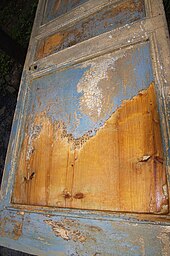
Paint stripping with caustic soda
Sodium hydroxide is used in the home as a blazon of drain opener to unblock chock-full drains, normally in the form of a dry out crystal or equally a thick liquid gel. The brine dissolves greases to produce water soluble products. It likewise hydrolyzes proteins, such as those found in pilus, which may block water pipes. These reactions are sped past the heat generated when sodium hydroxide and the other chemical components of the cleaner dissolve in h2o. Such alkaline bleed cleaners and their acidic versions are highly corrosive and should be handled with dandy caution.
Relaxer [edit]
Sodium hydroxide is used in some relaxers to straighten hair. However, because of the high incidence and intensity of chemical burns, manufacturers of chemical relaxers use other alkali metal chemicals in preparations available to consumers. Sodium hydroxide relaxers are still available, but they are used by and large past professionals.
Paint stripper [edit]
A solution of sodium hydroxide in h2o was traditionally used equally the most common paint stripper on wooden objects. Its use has become less common, because it can harm the wood surface, raising the grain and staining the colour.
H2o handling [edit]
Sodium hydroxide is sometimes used during water purification to heighten the pH of water supplies. Increased pH makes the h2o less corrosive to plumbing and reduces the amount of pb, copper and other toxic metals that tin dissolve into drinking water.[44] [45]
Historical uses [edit]
Sodium hydroxide has been used for detection of carbon monoxide poisoning, with blood samples of such patients turning to a vermilion colour upon the addition of a few drops of sodium hydroxide.[46] Today, carbon monoxide poisoning can be detected by CO oximetry.
In cement mixes, mortars, concrete, grouts [edit]
Sodium hydroxide is used in some cement mix plasticisers. This helps homogenise cement mixes, preventing segregation of sands and cement, decreases the amount of water required in a mix and increases workability of the cement product, be information technology mortar, render or concrete.
Experimental [edit]
Flavonoids [edit]
See: Sodium hydroxide examination for flavonoids
Summertime-wintertime heat storage [edit]
EMPA researchers are experimenting with concentrated sodium hydroxide (NaOH) as the thermal storage or seasonal reservoir medium for domestic space-heating. If water is added to solid or full-bodied sodium hydroxide (NaOH), heat is released. The dilution is exothermic – chemical energy is released in the class of heat. Conversely, by applying heat energy into a dilute sodium hydroxide solution the water will evaporate so that the solution becomes more than concentrated and thus stores the supplied heat as latent chemic energy.[47]
Neutron moderator [edit]
Seaborg Technologies is working on a reactor design in which NaOH is used every bit a neutron moderator.[48]
Safety [edit]

Chemic burns caused by sodium hydroxide solution photographed 44 hours after exposure.
Like other corrosive acids and alkalis, drops of sodium hydroxide solutions can readily decompose proteins and lipids in living tissues via amide hydrolysis and ester hydrolysis, which consequently cause chemical burns and may induce permanent incomprehension upon contact with eyes.[1] [2] Solid alkali can too express its corrosive nature if there is water, such equally water vapor. Thus, protective equipment, like rubber gloves, prophylactic vesture and eye protection, should always be used when treatment this chemical or its solutions. The standard beginning assist measures for brine spills on the pare is, equally for other corrosives, irrigation with large quantities of water. Washing is connected for at least ten to 15 minutes.
Moreover, dissolution of sodium hydroxide is highly exothermic, and the resulting heat may cause oestrus burns or ignite flammables. It also produces heat when reacted with acids.
Sodium hydroxide is likewise mildly corrosive to glass, which tin can cause damage to glazing or cause basis glass joints to bind.[49] Sodium hydroxide is corrosive to several metals, like aluminium which reacts with the brine to produce combustible hydrogen gas on contact:[50]
Storage [edit]
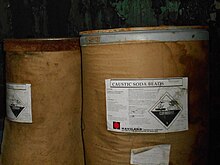
2 industrial fiberglass barrels of caustic-soda
Careful storage is needed when handling sodium hydroxide for use, especially bulk volumes. Following proper NaOH storage guidelines and maintaining worker/environs condom is always recommended given the chemical'due south burn chance.
Sodium hydroxide is often stored in bottles for minor-scale laboratory employ, within intermediate majority containers (medium volume containers) for cargo treatment and send, or within large stationary storage tanks with volumes upwardly to 100,000 gallons for manufacturing or waste matter water plants with extensive NaOH use. Common materials that are compatible with sodium hydroxide and often utilized for NaOH storage include: polyethylene (HDPE, usual, XLPE, less common), carbon steel, polyvinyl chloride (PVC), stainless steel, and fiberglass reinforced plastic (FRP, with a resistant liner).[14]
Sodium hydroxide must be stored in airtight containers to preserve its normality as information technology will blot water from the atmosphere.
History [edit]
Sodium hydroxide was first prepared by soap makers.[51] : p45 A procedure for making sodium hydroxide appeared as part of a recipe for making lather in an Arab book of the late 13th century: Al-mukhtara' fi funun min al-suna' (Inventions from the Various Industrial Arts), which was compiled by al-Muzaffar Yusuf ibn 'Umar ibn 'Ali ibn Rasul (d. 1295), a king of Yemen.[52] [53] The recipe called for passing water repeatedly through a mixture of alkali (Standard arabic: al-qily , where qily is ash from saltwort plants, which are rich in sodium; hence alkali was impure sodium carbonate)[54] and quicklime (calcium oxide, CaO), whereby a solution of sodium hydroxide was obtained. European lather makers also followed this recipe. When in 1791 the French chemist and surgeon Nicolas Leblanc (1742–1806) patented a process for mass-producing sodium carbonate, natural "soda ash" (impure sodium carbonate that was obtained from the ashes of plants that are rich in sodium)[51] : p36 was replaced by this artificial version.[51] : p46 Withal, past the 20th century, the electrolysis of sodium chloride had go the main method for producing sodium hydroxide.[55]
Come across also [edit]
- Acid and base of operations
- HAZMAT Class 8 Corrosive Substances
- List of cleaning agents
References [edit]
- ^ a b c "Textile Prophylactic Datasheet" (PDF). certified-lye.com.
- ^ a b c "Material Safety Datasheet ii" (PDF). hillbrothers.com. Archived from the original (PDF) on 2012-08-03. Retrieved 2012-05-20 .
- ^ a b "Sodium Hydroxide – Compound Summary". Retrieved June 12, 2012.
- ^ a b c d Haynes, p. four.90
- ^ Haynes, p. 4.135
- ^ Jacobs, H.; Kockelkorn, J. and Tacke, Thursday. (1985). "Hydroxide des Natriums, Kaliums und Rubidiums: Einkristallzüchtung und röntgenographische Strukturbestimmung an der bei Raumtemperatur stabilen Modifikation". Z. Anorg. Allg. Chem. 531 (12): 119–124. doi:x.1002/zaac.19855311217.
{{cite periodical}}: CS1 maint: multiple names: authors list (link) - ^ Haynes, p. 5.13
- ^ a b c NIOSH Pocket Guide to Chemical Hazards. "#0565". National Constitute for Occupational Condom and Health (NIOSH).
- ^ Michael Chambers. "ChemIDplus – 1310-73-2 – HEMHJVSKTPXQMS-UHFFFAOYSA-M – Sodium hydroxide [NF<nowiki"></nowiki"> – Similar structures search, synonyms, formulas, resource links, and other chemical data."]. nih.gov.
- ^ "Sodium hydroxide". Immediately Dangerous to Life or Health Concentrations (IDLH). National Institute for Occupational Safety and Health (NIOSH).
- ^ a b c d e f g Siemens, P. R.; Giauque, William F. (1969). "Entropies of the hydrates of sodium hydroxide. Ii. Low-temperature heat capacities and heats of fusion of NaOH·2H2O and NaOH·3.5H2O". Journal of Concrete Chemistry. 73 (i): 149–157. doi:10.1021/j100721a024.
- ^ "Examples of Mutual Laboratory Chemicals and their Hazard Class". Archived from the original on 2018-01-10. Retrieved 2018-01-09 .
- ^ a b c Cetin Kurt, Jürgen Bittner. "Sodium Hydroxide". Ullmann's Encyclopedia of Industrial Chemistry. Weinheim: Wiley-VCH. doi:x.1002/14356007.a24_345.pub2.
- ^ a b c d "Sodium Hydroxide Storage Tanks & Specifications". Protank. 2018-09-08. Retrieved 2018-xi-21 .
- ^ "Exothermic vs. Endothermic: Chemistry'due south Give and Have". Discovery Express.
- ^ a b c d e f g h i j k Umfreville Pickering, Spencer (1893). "LXI.—The hydrates of sodium, potassium, and lithium hydroxides". Periodical of the Chemical Society, Transactions. 63: 890–909. doi:10.1039/CT8936300890.
- ^ a b c d east Mraw, S. C.; Giauque, W. F. (1974). "Entropies of the hydrates of sodium hydroxide. III. Low-temperature heat capacities and heats of fusion of the α and β crystalline forms of sodium hydroxide tetrahydrate". Journal of Physical Chemistry. 78 (17): 1701–1709. doi:10.1021/j100610a005.
- ^ a b c d Murch, L. Eastward.; Giauque, W. F. (1962). "The thermodynamic properties of sodium hydroxide and its monohydrate. Heat capacities to low temperatures. Heats of solution". Journal of Physical Chemical science. 66 (ten): 2052–2059. doi:x.1021/j100816a052.
- ^ Brodale, G. Eastward.; Giauque, W. F. (1962). "The freezing betoken-solubility curve of aqueous sodium hydroxide in the region about the anhydrous-monohydrate eutectic". Journal of Physical Chemistry. 66 (10): 2051. doi:10.1021/j100816a051.
- ^ M. Conde Engineering: "Solid-Liquid Equilibrium (SLE) and Vapour-Liquid Equilibrium (VLE) of Aqueous NaOH". Online written report, accessed on 2017-04-29.
- ^ Jacobs, H. and Metzner, U. (1991). "Ungewöhnliche H-Brückenbindungen in Natriumhydroxidmonohydrat: Röntgen- und Neutronenbeugung an NaOH·H<sub">two</sub">O bzw. NaOD·D<sub">2</sub">O". Zeitschrift für anorganische und allgemeine Chemie. 597 (i): 97–106. doi:10.1002/zaac.19915970113.
{{cite journal}}: CS1 maint: multiple names: authors listing (link) - ^ 祖恩, 许 (1992), 钾素,钾肥溯源[J]
- ^ Stamell, Jim (2001), EXCEL HSC Chemistry, Pascal Printing, p. 199, ISBN978-i-74125-299-6
- ^ a b Fengmin Du, David M Warsinger, Tamanna I Urmi, Gregory P Thiel, Amit Kumar, John H Lienhard (2018). "Sodium hydroxide production from seawater desalination brine: process blueprint and free energy efficiency". Environmental Scientific discipline & Technology. 52 (10): 5949–5958. Bibcode:2018EnST...52.5949D. doi:10.1021/acs.est.8b01195. hdl:1721.one/123096. PMID 29669210.
{{cite journal}}: CS1 maint: multiple names: authors list (link) - ^ Kirk-Othmer Encyclopedia of Chemical Engineering science [ permanent dead link ] , fifth edition, John Wiley & Sons.
- ^ Deming, Horace G. (1925). Full general Chemical science: An Elementary Survey Emphasizing Industrial Applications of Fundamental Principles (2nd ed.). New York: John Wiley & Sons, Inc. p. 452.
- ^ "Document 2 - CausticSodamanual2008.pdf" (PDF). 2013. Archived from the original (PDF) on March 19, 2015. Retrieved July 17, 2014.
- ^ Sample, Ian (16 September 2009). "Trafigura case: toxic slop left behind by caustic washing". The Guardian . Retrieved 2009-09-17 .
- ^ "Trafigura knew of waste dangers". BBC Newsnight. 16 September 2009. Retrieved 2009-09-17 .
- ^ "A Guide to Caustic Chemicals Used in Lather Making | Brenntag". www.brenntag.com . Retrieved 2020-10-03 .
- ^ "Sodium Hydroxide | Uses, Benefits, and Chemical Safety Facts". ChemicalSafetyFacts.org. 2016-09-06. Retrieved 2020-10-03 .
- ^ Ayres, Chris (27 February 2010) Make clean light-green cease that sends a loved one down the drain Times Online. Retrieved 2013-02-twenty.
- ^ a b Thacker, H. Leon; Kastner, Justin (August 2004). Carcass Disposal: A Comprehensive Review. Chapter half dozen. National Agricultural Biosecurity Center, Kansas Country University, 2004. Retrieved 2010-03-08
- ^ Roach, Mary (2004). Stiff: The Curious Lives of Man Cadavers, New York: West.Due west. Norton & Company. ISBN 0-393-32482-6.
- ^ "Sodium:Getting rid of dirt – and murder victims". BBC News. 3 May 2014.
- ^ William Booth (January 27, 2009). "'Stewmaker' Stirs Horror in United mexican states". Washington Postal service.
- ^ "ATSDR – Medical Management Guidelines (MMGs): Sodium Hydroxide". www.atsdr.cdc.gov.
- ^ PubChem. "Aluminium sodium tetrahydroxide". pubchem.ncbi.nlm.nih.gov . Retrieved 2020-10-03 .
- ^ Morfit, Campbell (1856). A treatise on chemistry applied to the manufacture of soap and candles. Parry and McMillan.
- ^ "Side by Side Comparing: Potassium Hydroxide and Sodium Hydroxide - Similarities, Differences and Apply Cases". info.noahtech.com . Retrieved 2020-10-03 .
- ^ "Sodium Hydroxide". rsc.org. 2014. Retrieved November nine, 2014.
- ^ "Hominy without Lye". National Center for Home Food Preservation.
- ^ "Olives: Rubber Methods for Habitation Pickling (application/pdf Object)" (PDF). ucanr.org. 2010. Retrieved January 22, 2012.
- ^ "Drinking Water Handling – pH Adjustment". 2011. Archived from the original on August 10, 2018. Retrieved June 23, 2016.
- ^ Brian Oram, PG (2014). "Drinking Water Issues Corrosive H2o (Pb, Copper, Aluminum, Zinc and More)". Retrieved June 23, 2016.
- ^ Page 168 in: The Detection of poisons and strong drugs. Author: Wilhelm Autenrieth. Publisher: P. Blakiston's son & Company, 1909.
- ^ "Empa – 604 – Communication – NaOH-heat-storage". world wide web.empa.ch.
- ^ "OUR Engineering science". Seaborg . Retrieved 2021-06-09 .
- ^ Pubchem. "SODIUM HYDROXIDE | NaOH – PubChem". pubchem.ncbi.nlm.nih.gov . Retrieved 2016-09-04 .
- ^ "aluminium_water_hydrogen.pdf (application/pdf Object)" (PDF). www1.eere.free energy.gov. 2008. Archived from the original (PDF) on September 14, 2012. Retrieved January 15, 2013.
- ^ a b c Thorpe, Thomas Edward, ed., A Lexicon of Applied Chemical science (London, England: Longmans, Light-green, and Co., 1913), vol. 5, [i]
- ^ See: History of Science and Technology in Islam: Clarification of Soap Making
- ^ The English chemist and archaeologist Henry Ernest Stapleton (1878–1962) presented evidence that the Persian alchemist and physician Muhammad ibn Zakariya al-Razi (c. 865–925) knew about sodium hydroxide. Meet {{cite journal
Bibliography [edit]
- Haynes, William One thousand., ed. (2011). CRC Handbook of Chemical science and Physics (92nd ed.). CRC Press. ISBN978-1439855119.
External links [edit]
- International Chemical Safety Card 0360
- Euro Chlor-How is chlorine made? Chlorine Online
- NIOSH Pocket Guide to Chemical Hazards
- CDC – Sodium Hydroxide – NIOSH Workplace Safety and Health Topic
- Production past brine electrolysis
- Information sheets
- Sodium Hydroxide MSDS
- Certified Lye MSDS
- Hill Brothers MSDS
- Titration of acids with sodium hydroxide; freeware for data analysis, simulation of curves and pH calculation
- Caustic soda product in continuous causticising constitute past lime soda process

Specific Heat Of Sodium Hydroxide,
Source: https://en.wikipedia.org/wiki/Sodium_hydroxide
Posted by: steeltherstorted.blogspot.com
0 Response to "Specific Heat Of Sodium Hydroxide"
Post a Comment