

Narrow Inlet On The Coast

In physical geography, a fjord or fiord ([one]) is a long, narrow inlet with steep sides or cliffs, created by a glacier.[2] Fjords exist on the coasts of Alaska, Antarctica, British Columbia, Chile, Denmark, Germany, Greenland, the Faroe Islands, Iceland, Ireland, Kamchatka, the Kerguelen Islands, Labrador, Newfoundland, New Zealand, Norway, Novaya Zemlya, Nunavut, Quebec, the Patagonia region of Argentine republic and Chile, Russian federation, South Georgia Island, Tasmania, United kingdom, and Washington land.[iii] Norway's coastline is estimated to be 29,000 km (xviii,000 mi) long with its nearly one,200 fjords, but only 2,500 km (one,600 mi) long excluding the fjords.[4] [five]
Germination [edit]

A glacier in eastern Greenland flowing through a fjord carved by the move of ice

Illustration of how a fjord is created

A truthful fjord is formed when a glacier cuts a U-shaped valley by ice segregation and chafe of the surrounding bedrock.[6] Co-ordinate to the standard model, glaciers formed in pre-glacial valleys with a gently sloping valley flooring. The work of the glacier then left an overdeepened U-shaped valley that ends abruptly at a valley or trough end. Such valleys are fjords when flooded past the ocean. Thresholds above ocean level create freshwater lakes.[7] Glacial melting is accompanied past the rebounding of Globe's chaff as the ice load and eroded sediment is removed (also called isostasy or glacial rebound). In some cases this rebound is faster than body of water level ascension. About fjords are deeper than the adjacent sea; Sognefjord, Kingdom of norway, reaches every bit much as 1,300 g (iv,265 ft) below sea level. Fjords more often than not have a sill or shoal (bedrock) at their mouth caused past the previous glacier'south reduced erosion rate and terminal moraine.[eight] In many cases this sill causes farthermost currents and large saltwater rapids (run into skookumchuck). Saltstraumen in Norway is often described equally the world's strongest tidal current. These characteristics distinguish fjords from rias (e.g. the Bay of Kotor), which are drowned valleys flooded by the ascension ocean. Drammensfjorden is cut well-nigh in 2 by the Svelvik "ridge", a sandy moraine that during the ice cover was under sea level but after the post-glacial rebound reaches sixty m (200 ft) above the fjord.[9]
Jens Esmark in the 19th century introduced the theory that fjords are or take been created by glaciers and that large parts of Northern Europe had been covered by thick ice in prehistory.[10] Thresholds at the mouths and overdeepening of fjords compared to the body of water are the strongest evidence of glacial origin,[11] and these thresholds are generally rocky. Thresholds are related to sounds and low land where the water ice could spread out and therefore have less erosive force. John Walter Gregory argued that fjords are of tectonic origin and that glaciers had a negligible role in their formation. Gregory'south views were rejected by subsequent inquiry and publications. In the instance of Hardangerfjord the fractures of the Caledonian fold has guided the erosion past glaciers, while there is no clear relation between the direction of Sognefjord and the fold pattern.[10] This relationship betwixt fractures and management of fjords is also observed in Lyngen.[12] Preglacial, third rivers presumably eroded the surface and created valleys that afterwards guided the glacial flow and erosion of the boulder. This may in particular have been the case in Western Norway where the tertiary uplift of the landmass amplified eroding forces of rivers.[10]
Confluence of tributary fjords led to excavation of the deepest fjord basins. About the very coast the typical West Norwegian glacier spread out (presumably through sounds and low valleys) and lost their concentration and reduced the glaciers' power to erode leaving boulder thresholds. Bolstadfjorden is 160 m (520 ft) deep with a threshold of only ane.five m (four ft eleven in),[ten] [7] while the i,300 yard (4,300 ft) deep Sognefjorden has a threshold around 100 to 200 m (330 to 660 ft) deep.[13] [14] Hardangerfjord is made up of several basins separated by thresholds: The deepest basin Samlafjorden between Jonaneset (Jondal) and Ålvik with a distinct threshold at Vikingneset in Kvam.[ten]

Muldalsfossen waterfall drops several hundred meters from the Muldalen hanging valley to Tafjorden.
Hanging valleys are common along glaciated fjords and U-shaped valleys. A hanging valley is a tributary valley that is higher than the master valley and was created by tributary glacier flows into a glacier of larger volume. The shallower valley appears to exist 'hanging' to a higher place the main valley or a fjord. Often, waterfalls form at or near the outlet of the upper valley.[xv] Small waterfalls within these fjords are also used as freshwater resources. Hanging valleys likewise occur nether water in fjord systems. The branches of Sognefjord are for instance much shallower than the master fjord. The mouth of Fjærlandsfjord is about 400 m (i,300 ft) deep while the principal fjord is one,200 yard (3,900 ft) nearby. The mouth of Ikjefjord is only l meters deep while the chief fjord is around 1,300 one thousand (iv,300 ft) at the aforementioned signal.[eleven]
Features and variations [edit]

Hydrology [edit]
During the winter flavour there is usually little arrival of freshwater. Surface h2o and deeper water (downwards to 100 m or 330 ft or more) are mixed during winter because of the steady cooling of the surface and current of air. In the deep fjords at that place is notwithstanding fresh water from the summertime with less density than the saltier h2o forth the declension. Offshore wind, common in the fjord areas during wintertime, sets upward a current on the surface from the inner to the outer parts. This electric current on the surface in plough pulls dense salt water from the declension across the fjord threshold and into the deepest parts of the fjord.[xvi] Bolstadfjorden has a threshold of only ane.v m (iv ft eleven in) and strong inflow of freshwater from Vosso river creates a stagnant surface that blocks apportionment of the deep fjord. The deeper, salt layers of Bolstadfjorden are deprived of oxygen and the seabed is covered with organic material. The shallow threshold too creates a strong tidal current.[7]
During the summer season there is usually a large inflow of river water in the inner areas. This freshwater gets mixed with saltwater creating a layer of brackish water with a slightly higher surface than the ocean which in plough sets up a current from the river mouths towards the ocean. This current is gradually more than salty towards the coast and correct under the surface current there is a reverse current of saltier h2o from the coast. In the deeper parts of the fjord the cold h2o remaining from winter is notwithstanding and separated from the atmosphere by the stagnant top layer. This deep water is ventilated by mixing with the upper layer causing it to warm and freshen over the summer.[17] In fjords with a shallow threshold or low levels of mixing this deep water is non replaced every year and low oxygen concentration makes the deep water unsuitable for fish and animals. In the about extreme cases there is a constant barrier of freshwater on the surface and the fjord freezes over such that in that location is no oxygen below the surface. Drammensfjorden is one instance.[sixteen] The mixing in fjords predominantly results from the propagation of an internal tide from the entrance sill or internal seiching.[xviii]
The Gaupnefjorden branch of Sognefjorden is strongly afflicted by freshwater as a glacial river flows in. Velfjorden has little inflow of freshwater.[19]
Coral reefs [edit]
In 2000, some coral reefs were discovered along the bottoms of the Norwegian fjords.[20] These reefs were plant in fjords from the north of Norway to the south. The marine life on the reefs is believed to be i of the most important reasons why the Norwegian coastline is such a generous fishing footing. Since this discovery is fairly new, little research has been done. The reefs are host to thousands of lifeforms such as plankton, coral, anemones, fish, several species of shark, and many more than. Most are specially adapted to life under the greater pressure of the h2o column above information technology, and the total darkness of the deep ocean.[21]
New Zealand's fjords are also host to deep-water corals, merely a surface layer of night fresh water allows these corals to abound in much shallower water than usual. An underwater observatory in Milford Sound allows tourists to view them without diving.[22]
Skerries [edit]
In some places most the seaward margins of areas with fjords, the ice-scoured channels are then numerous and varied in management that the rocky declension is divided into thousands of isle blocks, some large and mountainous while others are merely rocky points or stone reefs, menacing navigation. These are called skerries.[21] The term skerry is derived from the Erstwhile Norse sker , which means a stone in the ocean.[23]
Skerries most commonly formed at the outlet of fjords where submerged glacially formed valleys perpendicular to the coast join with other cantankerous valleys in a complex array. The island fringe of Kingdom of norway is such a group of skerries (called a skjærgård ); many of the cross fjords are so arranged that they parallel the coast and provide a protected channel backside an almost unbroken succession of mountainous islands and skerries. By this aqueduct 1 can travel through a protected passage almost the entire one,601 km (995 mi) route from Stavanger to Due north Cape, Norway. The Blindleia is a skerry-protected waterway that starts nearly Kristiansand in southern Norway, and continues past Lillesand. The Swedish coast forth Bohuslän is too skerry guarded. The Within Passage provides a like route from Seattle, Washington, and Vancouver, British Columbia, to Skagway, Alaska. However some other such skerry protected passage extends from the Straits of Magellan north for 800 km (500 mi).
Phytoplankton [edit]
Fjords provide unique environmental weather for phytoplankton communities. In polar fjords, glacier and ice sail outflow add cold, fresh meltwater forth with transported sediment into the torso of h2o. Nutrients provided past this outflow can significantly enhance phytoplankton growth. For example, in some fjords of the West Antarctic Peninsula (WAP), nutrient enrichment from meltwater drives diatom blooms, a highly productive group of phytoplankton that enable such fjords to be valuable feeding grounds for other species.[24] It is possible that as climate change reduces long-term meltwater output, food dynamics inside such fjords will shift to favor less productive species, destabilizing the food spider web ecology of fjord systems.
In addition to food flux, sediment carried by flowing glaciers can become suspended in the water column, increasing turbidity and reducing low-cal penetration into greater depths of the fjord. This result tin limit the bachelor light for photosynthesis in deeper areas of the h2o mass, reducing phytoplankton abundance beneath the surface.[25]
Overall, phytoplankton affluence and species composition inside fjords is highly seasonal, varying as a result of seasonal light availability and water properties that depend on glacial melt and the formation of sea water ice. The study of phytoplankton communities within fjords is an agile expanse of research, supported by groups such equally FjordPhyto, a citizen science initiative to written report phytoplankton samples collected by local residents, tourists, and boaters of all backgrounds.
Epishelf lakes [edit]
An epishelf lake forms when meltwater is trapped backside a floating water ice shelf and the freshwater floats on the denser saltwater beneath. Its surface may freeze forming an isolated ecosystem.

Etymology [edit]
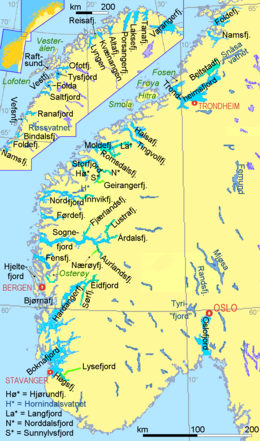
Important fjords and lakes in Norway. Note: The office of the map showing the northern fjords has a considerably smaller scale. Blurred coastlines = skerries
The word fjord is borrowed from Norwegian, where it is pronounced [ˈfjuːr], [ˈfjøːr], [ˈfjuːɽ] or [ˈfjøːɽ] in diverse dialects and has a more general meaning, referring in many cases to any long, narrow body of water, inlet or channel (for example, run into Oslofjord).
The Norwegian word is inherited from Old Norse fjǫrðr , a substantive which refers to a 'lake-like' sea used for passage and ferrying and is closely related to the noun ferð "travelling, ferrying, journey".[26] [27] Both words go back to Indo-European *pértus "crossing", from the root *per- "cross". The words fare and ferry are of the aforementioned origin.[28] [29]
The Scandinavian fjord, Proto-Scandinavian * ferþuz , is the origin for similar Germanic words: Icelandic fjörður , Faeroese fjørður , Swedish fjärd (for Baltic waterbodies), Scots firth .[27] [29] The Norse noun fjǫrðr was adopted in German language as Förde , used for the narrow long trophy of Schleswig-Holstein, and in English as firth "fjord, river mouth". The English word ford (compare German Furt , Low German Ford or Vörde , in Dutch names voorde such equally Vilvoorde, Ancient Greek πόρος , poros , and Latin portus ) is causeless to originate from Germanic *ferþu- and Indo-European root * pertu- meaning "crossing signal". Fjord/firth/Förde every bit well every bit ford/Furt/Vörde/voorde refer to a Germanic noun for a travel: North Germanic ferd or färd and of the verb to travel, Dutch varen , German fahren ; English to fare.[xxx]
As a loanword from Norwegian,[26] information technology is ane of the few words in the English to starting time with the sequence fj.[31] The word was for a long fourth dimension usually spelled fiord,[32] a spelling preserved in place names such as Grise Fiord. The fiord spelling mostly remains only in New Zealand English, as in the identify name Fiordland.[33]
[edit]


The use of the word fjord in Norwegian, Danish and Swedish is more than general than in English and in international scientific terminology. In Scandinavia, fjord is used for a narrow inlet of the sea in Norway, Kingdom of denmark and western Sweden, only this is non its only application. In Kingdom of norway and Iceland, the usage is closest to the Sometime Norse, with fjord used for both a firth and for a long, narrow inlet. In eastern Norway, the term is likewise applied to long narrow freshwater lakes (Randsfjorden and Tyrifjorden) and sometimes fifty-fifty to rivers (for case in Flå in Hallingdal, the Hallingdal river is referred to equally fjorden ). In southeast Sweden, the name fjard fjärd is a subdivision of the term 'fjord' used for bays, bights and narrow inlets on the Swedish Baltic Body of water declension, and in most Swedish lakes. This latter term is as well used for bodies of water off the coast of Finland where Finland Swedish is spoken. In Danish, the word may even apply to shallow lagoons. In modern Icelandic, fjörður is still used with the broader significant of firth or inlet. In Faroese fjørður is used both about inlets and virtually broader sounds, whereas a narrower sound is called sund . In the Finnish linguistic communication, a give-and-take vuono is used although there is only i fjord in Finland.
In quondam Norse genitive was fjarðar whereas dative was firði. The dative course has become mutual place names similar Førde (for instance Førde), Fyrde or Førre (for case Førre).[34]
The German use of the word Föhrde for long narrow bays on their Baltic Ocean coastline, indicates a common Germanic origin of the word. The landscape consists mainly of moraine heaps. The Föhrden and some "fjords" on the east side of Jutland, Denmark are likewise of glacial origin. Simply while the glaciers digging "real" fjords moved from the mountains to the sea, in Denmark and Germany they were tongues of a huge glacier roofing the basin of which is at present the Baltic Sea. See Förden and East Jutland Fjorde.
Whereas fjord names mostly describe bays (though not always geological fjords), straits in the same regions typically are named Sund, in Scandinavian languages as well equally in German. The give-and-take is related to "to sunder" in the meaning of "to separate". So the utilize of Sound to name fjords in North America and New Zealand differs from the European meaning of that word.
The proper name of Wexford in Ireland is originally derived from Veisafjǫrðr ("inlet of the mud flats") in Erstwhile Norse, equally used past the Viking settlers—though the inlet at that place in modern terms is an estuary, not a fjord.
Before or in the early phase of Onetime Norse angr was another common noun for fjords and other inlets of the ocean. This word has survived only equally a suffix in names of some Scandinavian fjords and has in aforementioned cases also been transferred to adjacent settlements or surrounding areas for instance Hardanger, Stavanger and Geiranger.[35] [36]
Differences in definitions [edit]
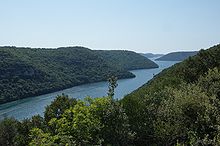
The Lim bay in Croatia is commonly called a fjord but is scientifically a ria.
The differences in usage between the English language and the Scandinavian languages have contributed to confusion in the apply of the term fjord. Bodies of water that are clearly fjords in Scandinavian languages are not considered fjords in English; similarly bodies of h2o that would clearly not be fjords in the Scandinavian sense take been named or suggested to be fjords. Examples of this confused usage follow.
In the Danish language some inlets are called a fjord, but are technically non a fjord. For example, Roskilde Fjord. Limfjord in English terminology is a sound, since it separates the Northward Jutlandic Island (Vendsyssel-Thy) from the rest of Jutland. However, the Limfjord one time was a fjord until the ocean broke through from the west. Ringkøbing Fjord on the western coast of Jutland is a lagoon. The long narrow fjords of Kingdom of denmark's Baltic Sea coast like the German Förden were dug by ice moving from the sea upon land, while fjords in the geological sense were dug past water ice moving from the mountains down to the sea. Yet, some definitions of a fjord is: "A long narrow inlet consisting of only i inlet created past glacial activity". Examples of Danish fjords are: Kolding Fjord, Vejle Fjord and Mariager Fjord.
The fjords in Finnmark (Norway), which are fjords in the Scandinavian sense of the term, are not universally considered to be fjords by the scientific customs.[37] Although glacially formed, virtually Finnmark fjords lack the steep-sided valleys of the more than southerly Norwegian fjords since the glacial pack was deep enough to cover even the loftier grounds when they were formed. The Oslofjord on the other hand is a rift valley, and non glacially formed.
"Fjords" not created past glaciers [edit]
The term fjord is sometimes applied to steep-sided inlets which were not created by glaciers. Most such inlets are drowned river canyons or rias. Examples are
- Bay of Kotor in Montenegro
- the Lim bay in Istria, Croatia, is sometimes called "Lim fjord" although it is a ria dug by the river Pazinčica. The Croats call it Limski kanal , which does not interpret precisely to the English equivalent either.
- In Acapulco, Mexico, the calanques—narrow, rocky inlets—on the western side of the city, where the famous cliff-divers perform daily, are described in the metropolis'southward tourist literature equally being fjords.
- The Fiordo di Furore in Italy is a ria
- The Khor ash Sham in the Musandam Peninsula in Oman, and other "khors" or inlets in the securely indented coast of Musandam, are often described as "fjords". They were formed by the subduction of the Arabian tectonic plate beneath the Eurasian plate.[38]
Freshwater fjords [edit]

Eidfjord village beneath the high terrace, the original ice-age delta. The river has carved a gorge through the terrace.
Some Norwegian freshwater lakes that have formed in long glacially carved valleys with sill thresholds, ice forepart deltas or terminal moraines blocking the outlet follow the Norwegian naming convention; they are frequently named fjords. Ice forepart deltas developed when the ice front was relatively stable for long time during the melting of the ice shield. The resulting landform is an isthmus between the lake and the saltwater fjord, in Norwegian called "eid" as in placename Eidfjord or Nordfjordeid. The post-glacial rebound changed these deltas into terraces up to the level of the original sea level. In Eidfjord, Eio has dug through the original delta and left a 110 g (360 ft) terrace while lake is but xix 1000 (62 ft) above sea level.[39] [40] Such deposits are valuable sources of high quality building materials (sand and gravel) for houses and infrastructure.[41] Eidfjord hamlet sits on the eid or isthmus between Eidfjordvatnet lake and Eidfjorden branch of Hardangerfjord.[42] Nordfjordeid is the isthmus with a village between Hornindalsvatnet lake and Nordfjord.[43] [44] Such lakes are also denoted fjord valley lakes by geologists.[45]
I of Norway's largest is Tyrifjorden at 63 m (207 ft) above sea level and an boilerplate depth at 97 m (318 ft) most of the lake is under ocean level. Norway's largest lake, Mjøsa, is also referred to as "the fjord" by locals.[40] Some other example is the freshwater fjord Movatnet (Mo lake) that until 1743 was separated from Romarheimsfjorden by an isthmus and connected by a curt river. During a overflowing in November 1743 the river bed eroded and sea h2o could flow into the lake at high tide. Eventually Movatnet became a saltwater fjord and renamed Mofjorden (Mofjorden [no]).[46] Like fjords, freshwater lakes are often deep. For case Hornindalsvatnet is at least 500 m (1,600 ft) deep and h2o takes an average of sixteen years to flow through the lake.[47] Such lakes created past glacial action are too chosen fjord lakes or moraine-dammed lakes.[48]
Some of these lakes were salt subsequently the ice age but after cut off from the ocean during the post-glacial rebound.[19] At the terminate of the water ice age Eastern Norway was nigh 200 m (660 ft) lower (the marine limit). When the ice cap receded and immune the ocean to fill up valleys and lowlands, and lakes similar Mjøsa and Tyrifjorden were role of the ocean while Drammen valley was a narrow fjord. At the time of the Vikings Drammensfjord was still four or 5 chiliad (13 or 16 ft) higher than today and reached the town of Hokksund, while parts of what is now the city of Drammen was under water.[49] After the ice age the ocean was nigh 150 k (490 ft) at Notodden. The bounding main stretched like a fjord through Heddalsvatnet all the way to Hjartdal. Mail service-glacial rebound eventually separated Heddalsvatnet from the ocean and turned it into a freshwater lake.[50] [51] In neolithic times Heddalsvatnet was still a saltwater fjord connected to the ocean, and was cut off from the ocean around 1500 BC.[52]
Some salt h2o fish got trapped in lakes that originally were office of the common salt fjord and gradually became freshwater fish such every bit the chill char.[53] Some freshwater fjords such as Slidrefjord are above the marine limit.
Similar freshwater fjords, the continuation of fjords on land are in the same fashion denoted as fjord-valleys. For instance Flåmsdal (Flåm valley) and Måbødalen.[ten] [54] [55]

Årdalstangen village on the small isthmus between Årdalsvatnet lake (behind) and Årdalsfjorden branch of Sognefjorden (front)
Outside of Kingdom of norway, the three western arms of New Zealand'due south Lake Te Anau are named North Fiord, Heart Fiord and South Fiord. Another freshwater "fjord" in a larger lake is Western Brook Pond, in Newfoundland's Gros Morne National Park; it is also oftentimes described as a fjord, but is actually a freshwater lake cut off from the sea, so is not a fjord in the English language sense of the term. Locally they refer to it every bit a "landlocked fjord". Such lakes are sometimes called "fjord lakes". Okanagan Lake was the first North American lake to be so described, in 1962.[56] The bedrock there has been eroded upward to 650 thou (2,133 ft) beneath sea level, which is 2,000 thou (six,562 ft) below the surrounding regional topography.[57] Fjord lakes are common on the inland lea of the Coast Mountains and Cascade Range; notable ones include Lake Chelan, Seton Lake, Chilko Lake, and Atlin Lake. Kootenay Lake, Slocan Lake and others in the basin of the Columbia River are also fjord-like in nature, and created by glaciation in the same manner. Along the British Columbia Coast, a notable fjord-lake is Owikeno Lake, which is a freshwater extension of Rivers Inlet. Quesnel Lake, located in central British Columbia, is claimed to exist the deepest fjord formed lake on Earth.
Great Lakes [edit]
A family of freshwater fjords are the embayments of the Due north American Bang-up Lakes. Baie Fine is located on the northwestern coast of Georgian Bay of Lake Huron in Ontario, and Huron Bay is located on the southern shore of Lake Superior in Michigan.
Locations [edit]
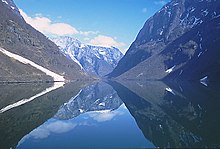
Sognefjord in Norway, the longest fjord in Norway,[27] is a popular tourist attraction


Tysfjord in Norway north of the Arctic Circle is located in the boreal zone


The principal mountainous regions where fjords take formed are in the college center latitudes and the high latitudes reaching to 80°N (Svalbard, Greenland), where, during the glacial period, many valley glaciers descended to the and so-lower bounding main level. The fjords develop best in mount ranges against which the prevailing westerly marine winds are orographically lifted over the mountainous regions, resulting in abundant snow to feed the glaciers. Hence coasts having the nigh pronounced fjords include the w coast of Norway, the westward coast of N America from Puget Sound to Alaska, the southwest declension of New Zealand, and the west and to southward-western coasts of S America, chiefly in Republic of chile.
Principal fjord regions [edit]
- Westward coast of Europe
- Faroe Islands
- Westfjords of Iceland
- Eastern Region of Iceland
- West Highlands of Scotland
- Kingdom of norway, the whole coast including Svalbard
- Kola Peninsula in Russia
- Due west coast of New Zealand
- Fiordland, in the southwest of the Due south Island
- Northwest coast of North America
- Coast of Alaska, United states of america: Lynn Canal, Glacier Bay, etc.
- British Columbia Coast, Canada: from the Alaskan Border along the Portland Canal to Indian Arm; Kingcome Inlet is a typical Due west Coast fjord.
- Hood Culvert in Washington, U.s.a. and various of the arms of Puget Audio
- Northeast coast of North America
- Labrador: Saglek Fjord, Nachvak Fjord, Hebron Fjord
- The east coast of Ungava Bay.
- Baffin Island
- Ellesmere Island
- Greenland: Kangerlussuaq, Ilulissat Icefjord, Scoresby Sund, Disko Island
- Saguenay Fjord, Quebec[58]
- Southwest coast of South America
- Fjords and channels of Chile
- Isla de los Estados, Argentina
Other glaciated or formerly glaciated regions [edit]
Other regions have fjords, only many of these are less pronounced due to more limited exposure to westerly winds and less pronounced relief. Areas include:
- Europe
- Ireland
- Lough Swilly
- Carlingford Lough
- Killary Harbour
- Russia (see likewise List of fjords of Russian federation)
- Chukchi Peninsula
- Kola Peninsula
- Scotland (where they are called firths, the Scots language cognate of fjord; lochs or sea lochs). Notable examples are:
- Loch Long
- Loch Fyne, Scotland's longest fjord at 65 km
- Loch Etive
- Sweden
- Gullmarsfjorden, in Bohuslän, Sweden
- Ireland
- North America
- Canada:
- the due west and due south coasts of Newfoundland, particularly:
- Facheux Bay
- Bonne Bay in Gros Morne National Park
- Aviron Bay
- La Hune Bay
- Bay de Vieux
- White Bear Bay
- Baie d'Espoir
- La Poile Bay
- Bay Le Moine
- the Canadian Chill Archipelago
- the due west and due south coasts of Newfoundland, particularly:
- U.s.:
- Somes Sound, Acadia National Park, Maine
- Hudson River
- nearly conspicuously seen at The Palisades
- Puget Audio
- Canada:
- S America
- Argentine republic:
- Isla de los Estados
- Argentine republic:
- Arctic
- Arctic islands
- Novaya Zemlya
- Severnaya Zemlya
- Arctic islands
- Antarctica
- S Georgia (Great britain)
- Kerguelen Islands (French republic)
- particularly the Antarctic Peninsula
- Sub-Antarctic islands

Extreme fjords [edit]
The longest fjords in the world are:
- Scoresby Sund in Greenland—350 km (217 mi)[59] [60]
- Greely Fiord/Tanquary Fiord in Canada—230 km (143 mi)[ commendation needed ] The length of the total fjord system from the head of Tanquary Sound, through Greely Fjord, to the oral fissure of Nansen Sound is approximately 400 km, making it arguably the longest fjord in the world.[ citation needed ]
- Sognefjord in Kingdom of norway—204 km (127 mi)[61]
- Independence Fjord in Greenland—200 km (124 mi)
- Matochkin Shar, Novaya Zemlya, Russia—125 km (78 mi) (a strait with a fjord structure)[62]
Deep fjords include:
- Skelton Inlet in Antarctica—ane,933 m (6,342 ft)
- Sognefjord in Norway—1,308 m (4,291 ft)[63] [61] (the mountains then ascension to upward to i,500 chiliad (4,921 ft) and more, Hurrungane reaches ii,400 g (7,874 ft))[64]
- Messier Aqueduct in Tortel, Chile—1,358 one thousand (4,455 ft)[65] [66]
- Baker Channel in Tortel, Chile—i,251 m (iv,104 ft)
Encounter also [edit]
- Firth
- Förden and Eastward Jutland Fjorde
- Fjard
- Ria
Notes [edit]
- ^ "fjord". Merriam-Webster Lexicon.
- ^ "What is a Fjord, and how is it formed". Norway Today. 2016-05-08. Retrieved 2017-12-30 .
- ^ Syvitsky, James P. M.; Burrell, David C.; Skei, Jens M. (1987). Fjords: Processes and Products. New York: Springer. pp. 46–49. ISBN0-387-96342-ane.
The NE declension, from Victoria Fjord to the Scoresby Sund fjord circuitous ..., has approximately sixty major fjords, some of them the world'due south largest and deepest. ... The SE coast, from Scoresby Sund to Kap Farvel ..., has approximately 100 fjords.
- ^ "Geografiske forhold (Geography of Norway)". Statistics Norway. Retrieved 24 March 2016.
- ^ Gregory, J. Westward. (1913). The Nature and Origin of Fiords. London: John Murray.
- ^ Murton, Julian B.; Peterson, Rorik; Ozouf, Jean-Claude (17 Nov 2006). "Bedrock Fracture by Ice Segregation in Cold Regions". Science. 314 (5802): 1127–1129. Bibcode:2006Sci...314.1127M. doi:ten.1126/science.1132127. PMID 17110573. S2CID 37639112.
- ^ a b c Aarseth, I., Nesje, A., & Fredin, O. (2014). W Norwegian fjords. Geological Guild of Norway (NGF), Trondheim, 2014. ISBN 978-82-92-39491-five
- ^ Alley, R.B.; D. E. Dawson; Thou. J. Larson; E. B. Evenson; G. South. Baker (14 August 2003). "Stabilizing feedbacks in glacier-bed erosion". Nature. Nature PublishingGroup. 424 (6950): 758–760. Bibcode:2003Natur.424..758A. doi:10.1038/nature01839. PMID 12917679. S2CID 4319448.
- ^ Jørgensen, Per: Kvartærgeologi. Landbruksforlaget, 1995.
- ^ a b c d e f Holtedahl, H. (1967). Notes on the formation of fjords and fjord-valleys. Geografiska Annaler. Series A. Physical Geography, 49(ii/iv): 188-203.
- ^ a b Nesje, Atle; Whillans, Ian M. (1 February 1994). "Erosion of Sognefjord, Kingdom of norway". Geomorphology. nine (1): 33–45. Bibcode:1994Geomo...9...33N. doi:10.1016/0169-555X(94)90029-9. ISSN 0169-555X. Retrieved 20 September 2021.
- ^ Randall, B. A. O. (1961). On the relationship of valley and fjord directions to the fracture pattern of Lyngen, Troms N. Norway. Geografiska Annaler, 43(3/4), 336-338.
- ^ Geografisk leksikon, edited by Waldemar Brøgger. Oslo: Cappelen, 1963.
- ^ "Sognefjorden". xv Baronial 2021.
- ^ "Glossary of Glacier Terminology". U.S. Geological Survey. May 28, 2004. Retrieved 2007-05-24 .
- ^ a b Skreslet, Stig (1980). Fjordene og kyststrømmen. Rauma/Ulvåa på vektskåla. Åndalsnes: Møre og Romsdal naturvern. pp. 48–54.
- ^ J.H. Simpson and T.P. Rippeth (1993). The Clyde Sea - a model of seasonal stratification and mixing. Estuarine, Coastal and Shelf Science. 37, 129-144
- ^ Arneborg, 50., Janzen, C., Liljebladh, B., Rippeth, T., Simpson, J. H. & Stigebrandt, A. (2004). Spatial variability of diapycnal mixing and turbulent dissipation rates in a stagnant fjord basin. Journal of Physical Oceanography, 34(7), 1679-1691
- ^ a b "Fjord". Norwegian Biodiversity Information Heart. Archived from the original on 3 February 2016. Retrieved 30 Jan 2016.
- ^ Institute of Marine Inquiry: Coral reefs in Kingdom of norway Archived 2008-ten-11 at the Wayback Auto
- ^ a b "Fjord". National Geographic . Retrieved April 24, 2015.
- ^ Paddy Ryan. Fiords – Underwater rock walls and basins, Te Ara – the Encyclopedia of New Zealand. Updated 21 September 2007. Accessed 2008-04-18.
- ^ Moore 1890, p. 277.
- ^ Mascioni, Martina; Almandoz, Gastón O.; Ekern, Lindsey; Pan, B. Jack; Vernet, Maria (2021-12-01). "Microplanktonic diatom assemblages dominated the primary product but not the biomass in an Antarctic fjord". Journal of Marine Systems. 224: 103624. Bibcode:2021JMS...22403624M. doi:10.1016/j.jmarsys.2021.103624. ISSN 0924-7963.
- ^ Kang, Sung-Ho; Kim, Yea-Dong; Kang, Jae-Shin; Yoo, Kyu-Cheul; Yoon, Ho-Il; Lee, Won-Cheol (2003). "Monitoring on the Marine Environment and Phytoplankton of Kongsfjorden, Svalbard, Chill". Bounding main and Polar Research. 25 (2): 213–226. doi:x.4217/OPR.2003.25.2.213. ISSN 1598-141X.
- ^ a b Nesje, A. (2009). Fjords of Norway: Complex Origin of a Scenic Mural. In Geomorphological Landscapes of the Globe (pp. 223-234). Springer, Dordrecht.
- ^ a b c Lilleøren, Karianne (2021). "fjord". Store norske leksikon . Retrieved 11 Dec 2021.
- ^ Helleland, Botolv (1975). Norske stedsnavn/stadnamn. Oslo: Grøndahl. ISBN 8250401042.
- ^ a b Migon, P. (Ed.). (2010). Geomorphological landscapes of the earth. Springer Science & Concern Media, p. 223.
- ^ de Caprona, Yann (2014). Norsk etymologisk ordbok. Kagge. ISBN978-8-2489-1054-1.
- ^ fjeld is another
- ^ Fowler, H. W. (10 September 2009) [1926]. A Dictionary of Modern English Usage:The Archetype First Edition: The Archetype Get-go Edition. OUP Oxford. p. 181. ISBN978-0-19-953534-7.
The OED gives precedence to fi-. The other spelling is apparently used in English language to help the ignorant to call it fyord; every bit, instead of helping, it but puzzles them, it should exist abased
- ^ Ryan, Paddy (12 June 2016). "Fiords". Te Ara - the Encyclopedia of New Zealand . Retrieved 3 March 2022.
- ^ Rygh, O. (1898). Norske Gaardnavne: Oplysninger samlede til Brug ved Matrikelens Revision. Kristiania: Fabritius.
- ^ Rygh, O. (1896). Norske Fjordnavne. Kristiania: Aschehoug.
- ^ Helle, Knut (1975). Stavanger: fra våg til by. Stavanger: Stabenfeldt. ISBN 8253201893.
- ^ Bird, Eastward.C.F. (2008) Coastal Geomorphology: An Introduction, 2nd ed. John Wiley and Sons Ltd. Due west Sussex, England. ISBN 978-0-470-51729-1
- ^ "The hardship posting to stop all hardship postings". BBC. 25 October 2014.
- ^ Geografi: landskap, ressursar, menneske, miljø. Oslo: Cappelen, 1999. ISBN 8202173078.
- ^ a b Gustav Indrebø (1924): Norske innsjønavn: Upplands fylke. Skrifter (Videnskabsselskapet i Kristiania), Historisk-filosofisk klasse.
- ^ Ramberg, I. B. (Ed.). (2008). The making of a state: geology of Kingdom of norway. Geological Society of London.
- ^ Brekke, Nils Georg; Skaar, Ronny B and Nord, Svein (1993). Kulturhistorisk Vegbok Hordaland. Nord4.
- ^ Tveit, Olav Jakob (1998). Indre Nordfjord. Oslo: Lunde. ISBN 8252031609.
- ^ Indre Nordfjord: geologi og landskap. Oppstryn: Jostedalsbreen nasjonalparksenter, 1995.
- ^ Bogen, J. (1983). Morphology and sedimentology of deltas in fjord and fjord valley lakes. Sedimentary Geology, 36(2-4), 245-267.
- ^ Bygdebok for Modalen og Eksingedalen. Bind 2. Sogenemnda, 1990.
- ^ NVE Atlas. Vassdrag – Innsjødatabase – Dybdekart Archived 2015-06-26 at the Wayback Auto (National lakes database). Norges vassdrags- og energidirektorat (Norwegian H2o Resources and Energy Directorate). Accessed xiii June 2015
- ^ Strøm, Kaare (1959). Innsjøenes verden. Oslo: Universitetsforlaget.
- ^ Johansen, Øystein Klock (1994). Fra fangstmann til viking. Hokksund: Øvre Eiker kommune.
- ^ Telemark. Oslo: Gyldendal. 1975. ISBN 8205068445.
- ^ Norge sett fra luften. Oslo: Det Beste. 1980. ISBN 8270100935.
- ^ Mikkelsen, Egil (1989). Fra jeger til bonde: utviklingen av jordbrukssamfunn i Telemark i steinalder og bronsealder. Oslo: Universitetets oldsaksamling. ISBN 8271810790.
- ^ Berger, Hans Mack (1999). Utbredelse og status for ferskvannsfisk i innsjøer i Nord-Trøndelag. Trondheim: NINA – Norsk institutt for naturforskning. ISBN8242610517.
- ^ Hansen, L., Eilertsen, R. South., Solberg, I. L., Sveian, H., & Rokoengen, Grand. (2007). Facies characteristics, morphology and depositional models of clay-slide deposits in terraced fjord valleys, Norway. Sedimentary Geology, 202(4), 710-729.
- ^ Lidmar-Bergström, K., Ollier, C. D., & Sulebak, J. R. (2000). Landforms and uplift history of southern Kingdom of norway. Global and Planetary Change, 24(iii), 211-231.
- ^ Nasmith, Hugh (1962). "Late glacial history and surficial deposits of the Okanagan Valley, British Columbia". Victoria, BC, Canada: BC Ministry of Energy, Mines and Petroleum Resources.
- ^ Eyles, Nicholas; Mullins, Henry T.; Hine, Albert C. (1990). "Thick and fast: Sedimentation in a Pleistocene fiord lake of British Columbia, Canada". Geology. 18 (11): 1153–1157. Bibcode:1990Geo....xviii.1153E. doi:10.1130/0091-7613(1990)018<1153:TAFSIA>2.3.CO;2.
- ^ "Saguenay River". The Canadian Encyclopedia. Archived from the original on 22 August 2012. Retrieved viii Dec 2012.
- ^ Sandell, Hanne Tuborg; Sandell, Birger (1991). Archeology and Environment in the Scoresby Sund Fjord. Museum Tusculanum Press. p. 7. ISBN87-635-1208-iv.
{{cite book}}: CS1 maint: uses authors parameter (link) - ^ Migoń, Piotr, ed. (2010). Geomorphological Landscapes of the World. Springer. p. 227. ISBN978-90-481-3054-2.
- ^ a b Øi, Ørnulf (1987). Norges sjøatlas : fra svenskegrensen til Sognefjorden. Oslo: Nautisk forlag i samarbeid med Statens kartverk, Norges sjøkartverk. pp. 225, 244. ISBN8290335024.
- ^ Alexander P. Lisitzin, Sea-Ice and Iceberg Sedimentation in the Bounding main: Recent and By, p. 449.
- ^ Store norske leksikon. "Sognefjorden" (in Norwegian). Retrieved 2010-09-04 .
- ^ Andersen, Bjørn Grand. (2000). Istider i Norge. Landskap formet av istidenes breer. Oslo: Universitetsforlaget. p. 30. ISBN9788200451341.
- ^ "The Deepest Fjords in The World". WorldAtlas. 2018-11-26. Retrieved 2022-05-26 .
- ^ Piret, Loic; Bertrand, Sebastien; Vandekerkhove, Elke; Harada, Naomi; Moffat, Carlos; Rivera, Andres (2017-09-09). "Gridded bathymetry of the Bakery-Martinez fjord complex (Chile, 48°S) v1". Figshare. doi:10.6084/m9.figshare.5285521.v3.
Bibliography [edit]
- Moore, Arthur William (1890). The Surnames & Place-Names of the Isle of Human being. E. Stock. p. 2. ISBN978-1110309573 . Retrieved April 24, 2015.
surnames and identify-names of isle of man.
External links [edit]

Look up fjord in Wiktionary, the free dictionary.

Wikimedia Commons has media related to Fjord.

Wikivoyage has a travel guide for Fjord .
- Utilise of whales to probe Chill fjord'due south secrets
- Fiordland'due south Marine Reserves Department of Conservation
- Nextstopnorway – Listing of Norwegian fjords
- Saguenay River – The Canadian Atlas Online

Narrow Inlet On The Coast,
Source: https://en.wikipedia.org/wiki/Fjord
Posted by: steeltherstorted.blogspot.com
0 Response to "Narrow Inlet On The Coast"
Post a Comment